AES struggles: how rhetoric overshadows real challenges in the Sahel
Three years after military takeovers in Mali, Burkina Faso and Niger, the Alliance of Sahel States (AES) faces a harsh reality: persistent security threats, economic strain, and unmet public expectations. While the bloc’s leadership has prioritized breaking from regional norms and challenging traditional partners, tangible improvements remain elusive.
The limits of sovereignty as a political strategy
The AES’s sovereignist rhetoric has resonated with segments of the Sahelian public, reflecting frustration over years of insecurity and perceived failures in international cooperation. The push for greater control over diplomatic and military decisions has struck a chord, particularly among those wary of external interference.
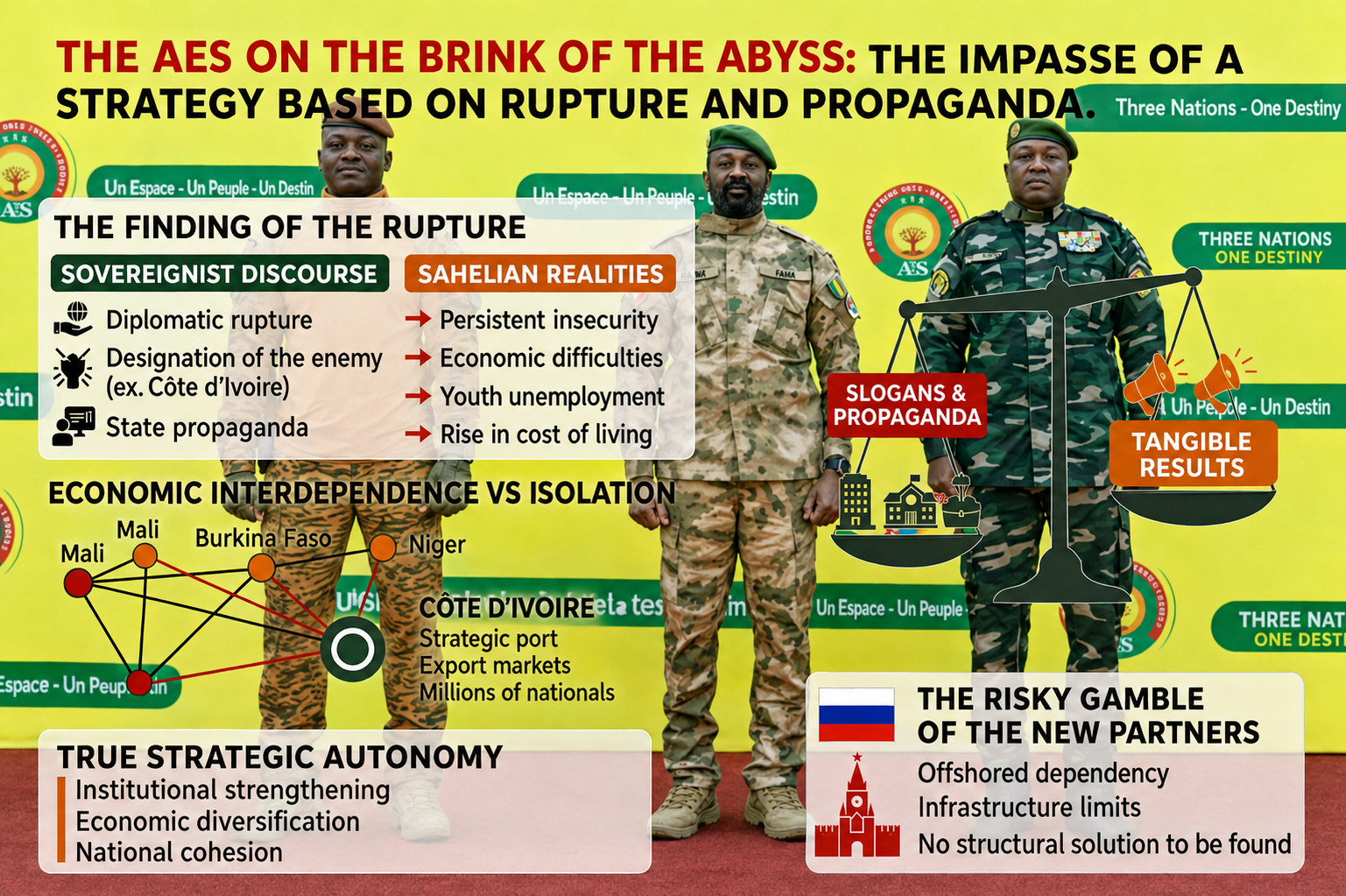
Yet sovereignty extends beyond rejecting agreements or rebranding alliances. It demands tangible outcomes: ensuring citizen safety, fostering job creation, attracting investment, delivering efficient public services, and improving living standards. On these fronts, the AES’s record falls short.
External enemies as a political tool
When governments struggle to deliver visible progress, political messaging often shifts focus to adversaries. For the AES, neighboring states like Côte d’Ivoire are frequently framed as hostile actors or foreign proxies, a tactic that can galvanize domestic support in the short term.
This approach, however, carries significant drawbacks. It diverts attention from pressing issues such as youth unemployment, rising living costs, and crumbling infrastructure. It also risks deepening unnecessary diplomatic rifts, undermining economic ties that bind Sahelian and West African nations. Worse, it risks stifling dissent by equating internal criticism with loyalty to external enemies.
Côte d’Ivoire’s steady hand amid regional tensions
Despite occasional verbal attacks, Côte d’Ivoire has maintained a diplomatic stance rooted in dialogue and stability—a legacy rooted in the mediation-focused policies of Félix Houphouët-Boigny. Abidjan’s strategy prioritizes economic pragmatism over escalation, reflecting the reality that regional trade and infrastructure ties are too intertwined to sever over political rhetoric.
The country serves as a critical commercial hub for landlocked Sahelian nations, with its port handling a significant share of imports and exports. Millions of Malians, Burkinabés, and Nigeriens live, work, or invest in Côte d’Ivoire. A prolonged deterioration in relations would thus inflict human and economic damage far outweighing temporary political gains.
The hidden costs of diplomatic confrontation
The economic fallout from regional tensions is often underestimated. Confrontation can chill foreign investment, disrupt trade flows, inflate logistics costs, and erode investor confidence—particularly in economies already strained by security challenges. Political uncertainty alone is enough to deter businesses, slowing job creation and stifling growth.
New alliances, old challenges
The AES’s pivot toward alternative international partners, notably Russia, reflects a sovereign right to diversify alliances. Yet such moves do not automatically resolve structural issues like weak institutions, underinvestment in productive sectors, rural poverty, or territorial governance failures. History shows no external partner can single-handedly address these deep-rooted problems.
The risk lies in swapping one dependency for another without addressing the underlying causes of Sahelian instability. True strategic autonomy requires bolstering national institutions, professionalizing security forces, improving business climates, diversifying economies, and investing in human capital.
Communication without concrete progress
The AES leadership has amplified a narrative of sovereignty, resistance, and national recovery. While such messaging can bolster national pride, it cannot indefinitely substitute for tangible results. Citizens ultimately judge their leaders on hard metrics: safer streets, affordable living, youth employment, functional schools and clinics, modern infrastructure, and inclusive growth. Long-term legitimacy hinges on these outcomes far more than slogans or media campaigns.
Why West Africa needs cooperation, not division
The Sahel’s challenges—terrorism, transnational crime, migration, climate change, food insecurity, and economic development—transcend national borders. No single state can tackle them alone. Regional cooperation remains essential, whether through existing organizations or innovative partnerships.
Treating neighbors like Côte d’Ivoire as perpetual adversaries only weakens a region already grappling with multiple crises.
Conclusion
The AES emerged from a rejection of a perceived ineffective model, a sentiment shared by many in the Sahel. Yet rejection alone does not constitute a policy. The bloc’s credibility will ultimately hinge not on sovereignist rhetoric but on its ability to deliver security, revive economies, uphold public freedoms, and restore regional trust.
The Sahel’s future depends less on identifying scapegoats than on its leaders’ capacity to produce tangible results, rebuild citizen trust, and transform dialogue into a tool for stability rather than perpetual confrontation.
