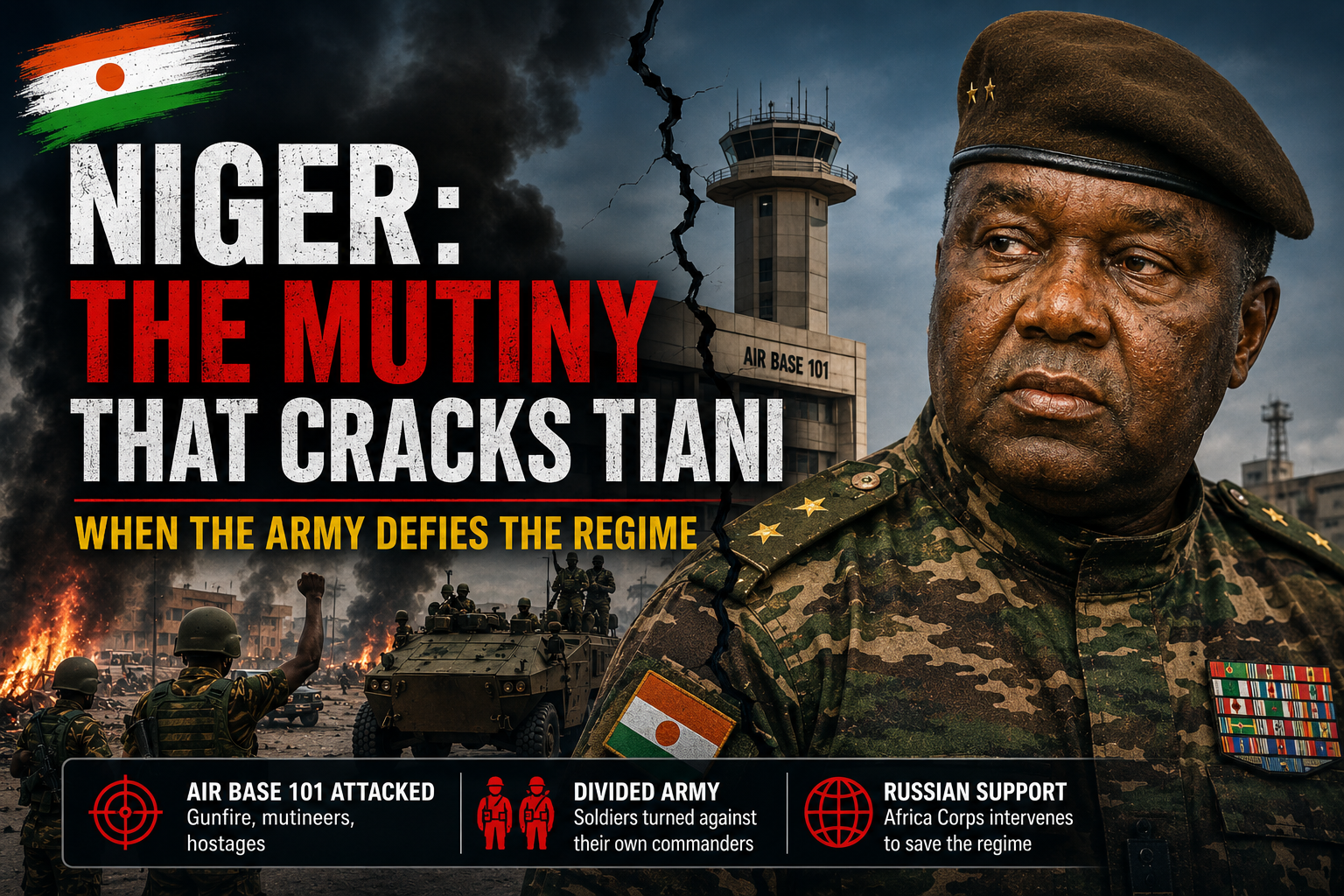
A military uprising in Niamey challenges Niger’s leadership
The profound events of Saturday, August 29, 2026, in Niamey transcend official narratives attempting to portray them as simple “revolutionary zeal” among military personnel. The coordinated assault by armed forces on Air Base 101 and several critical installations within the capital signifies a particularly severe disruption in the recent history of the current administration. Even the authorities conceded that a faction of soldiers had detained colleagues before initiating gunfire at strategic points.
Consequently, the magnitude of this occurrence extends far beyond a mere expression of discontent. When military defiance targets a strategic base situated centrally in the capital, when gunfire echoes near the airport and presidential complex, and when state broadcasting is momentarily silenced, it is the very framework of governance that faces an existential challenge. Reports indicate sustained exchanges of fire reverberated for several hours around the airport and the presidential residence, concurrently with the cessation of state television and radio transmissions throughout the morning.
A schism originating internally
The assertion that the mutineers were merely soldiers eager to accelerate geopolitical shifts fails to account for the significance of the targets engaged. When elements of the Nigerien military direct their actions against strategic infrastructure within their own capital and engage forces loyal to the regime, the issue transcends ideological differences, becoming fundamentally institutional.
The core concern then shifts to the cohesion of the military establishment itself. While an armed force can withstand political disagreements, internal frustrations, or rivalries, it becomes profoundly susceptible when such tensions escalate into armed confrontation between personnel belonging to the same national entity.
This internal division is particularly alarming given that the forces implicated are not depicted as a small group of disaffected individuals lacking access to security structures. Available intelligence suggests the involvement of military personnel originating from various regions, including Ouallam, Téra, and Dosso, who successfully penetrated a site as critical as Air Base 101.
The paradox of a regime presumed to be impregnable
Since assuming power in July 2023, the administration led by General Abdourahamane Tiani has consistently articulated a vision centered on national sovereignty, enhanced security, and a comprehensive restructuring of the military apparatus.
Yet, three years subsequent to its inception, the government finds itself confronted by an armed challenge emerging precisely from within this very security framework.
This represents one of the profound paradoxes at the heart of the current crisis.
A governing body that asserts having reasserted state control, overhauled national defense, and fortified Niger’s sovereignty should, in theory, possess an exceptionally robust chain of command. Nevertheless, soldiers managed to seize control of vital military infrastructure, detain some of their comrades, and initiate clashes in the capital before loyalist forces gradually re-established command.
Even though the mutiny was eventually brought under control, its mere occurrence serves as a significant warning.
Sovereignty tested by reliance on the Africa Corps
A further element that undermines the official narrative is the reported involvement of Russian Africa Corps forces in the recapture of Air Base 101.
Regional media outlets have indicated that Russian elements provided support to forces loyal to the regime during the recovery of this strategic installation.
This situation introduces a substantial political contradiction.
The Tiani administration has consistently championed national sovereignty as a cornerstone of its legitimacy. However, when order was imperiled at the very core of the capital, the Nigerien military apparatus appeared sufficiently compromised that the assistance of an external military partner became a decisive factor in the response.
The issue extends beyond the mere presence of Russian forces. It lies in the symbolism conveyed: that of a leadership purporting to have restored the state’s full operational capability, yet compelled to rely on an external force to secure some of its most strategic locations.
This reliance also risks exacerbating frustrations within a national army already experiencing internal tensions. Should Nigerien soldiers perceive foreign partners gaining an increasingly prominent role in security operations, the question of their own contribution to national defense could become highly volatile.
A military triumph does not resolve the political crisis
The successful recapture of Air Base 101 and the surrender of numerous mutineers undoubtedly represent a tactical achievement for the government. However, a military victory does not necessarily signify the eradication of the underlying causes of the uprising.
Nigerien authorities may re-secure a barracks, apprehend soldiers, and restore order in the streets. Yet, they will face a far more complex inquiry: why did military personnel, integral to the defense apparatus, choose to revolt against their own command structures?
This precise question is likely to challenge the regime in the coming months.
Suppressing a mutiny can prevent an immediate seizure of power, but it is not always sufficient to restore trust among the various components of the armed forces.
The security front remains the backdrop to this crisis
This internal schism also unfolds against a backdrop where the regime’s core pledge—the restoration of security—remains unfulfilled.
Tiani had established the fight against jihadist groups and the reassertion of security sovereignty as fundamental tenets of his rule. Nevertheless, jihadist assaults continue across Niger, while the capital itself experienced multiple attacks targeting airport and military installations in 2026.
The contrast is therefore striking: while the government presents its security framework as a decisive break from previous strategies, the jihadist threat persists, and a new menace has now emerged from within the military itself.
The regime must thus simultaneously address two critical challenges: containing the armed groups operating within the territory and preventing internal frustrations within the military apparatus from escalating into further insurrections.
The myth of unity begins to fracture
For an extended period, the military leadership successfully projected an image of being the focal point for national mobilization against the former political order and external influences.
However, the mutiny of August 29 reveals a far more intricate reality.
The outward display of unity surrounding the CNSP clearly does not reflect unanimous support across the entirety of the armed forces. The challenge to authority is no longer solely external; it has manifested within the very institution tasked with guaranteeing the regime’s stability.
This is precisely what renders the event so disconcerting for Tiani.
A regime can endure political opposition and even international criticism. However, when elements of its own military apparatus begin to take up arms against the government, the question of its fundamental stability becomes considerably more difficult to circumvent.
A warning rather than a mere incident
It would therefore be premature to characterize the August 29 mutiny as the downfall of the Tiani regime. Loyalist forces successfully reclaimed Air Base 101, and authorities have announced the re-establishment of control over the situation.
Nevertheless, it would be equally imprudent to dismiss this episode as a mere disciplinary infraction.
For the first time since the coup d’état of 2023, the Tiani administration has confronted a military challenge of sufficient gravity to instigate confrontations across several strategic areas of Niamey.
The mutiny, while militarily unsuccessful, effectively exposed a political vulnerability: beneath the facade of a tightly controlled regime, deep divisions exist within the very apparatus intended to ensure its continuity.
And perhaps this is the profound lesson of August 29: Tiani may have prevailed in the battle for Niamey, but he has now ascertained that the most formidable threat to his authority could emanate from within.
